
On August 13, professional tennis saw something it hadn’t in 23 years: two American men reached the final of a Masters 1000, the tournament tier just below a Grand Slam in terms of prestige and ranking points. It was in Montreal, where 25-year-old Brandon Nakashima met 23-year-old Ben Shelton to battle it out for the National Bank Open title. Shelton prevailed, yet Nakashima showed serious mettle in getting there (and then did so again just a few days later by reaching the semifinals of another Masters 1000 in Cincinnati).
While names like Shelton, Frances Tiafoe, Taylor Fritz, and Tommy Paul have all held the spotlight in the American men’s tennis scene for several years now, Nakashima represents the cohort of burgeoning stars breathing down their necks. The depth of the national field is arguably stronger than its been in decades—from 20-year-old Learner Tien, who recently reached a career-high ranking of 12, to Michael Zheng, a buzzy Flushing Meadows-trained and Columbia University-honed player from Montville, New Jersey. With the US Open’s main draw kicking off on Sunday, there’s a real possibility of some homegrown breakthroughs.
“I think the game is just evolving to a point where, you know, the guys who are coming in from the juniors and from college are able to make the transition fairly quickly,” says Chris Eubanks, a retired American player and current analyst for the Tennis Channel and ESPN. “These guys are getting to the tour level and they’re able to remain fairly consistent from the onset. That feels new and exciting.”
Prakash Amritraj, a host for the Tennis Channel, says he thinks there’s “definitely a momentum shift” and that many of these men are “moving fast up the rankings.” But, he cautions, “the only thing I’ll say with them is that this is still new territory. They have potentially unbelievably bright futures, but it’s like climbing Mount Everest. You’ve got to get used to the air at the higher altitude. It’s tougher to breathe.”
As it’s often noted, it’s been 23 years since an American man won a Grand Slam. Andy Roddick was the last to do so at the 2003 US Open. In recent times, Fritz came close, reaching the US Open final in 2024. And while this “Slam drought” remains ongoing, Eubanks argues that the long winless stretch has “no real bearing on the players.”
“Yes, they want to win Grand Slams,” Eubanks says. “But I think the ‘drought’ is far more of a media talking point than what the players are talking about.” He also points out that it’s not a US-specific issue; France, another country with a history of elite players, hasn’t seen a male athlete win a major since 1983.
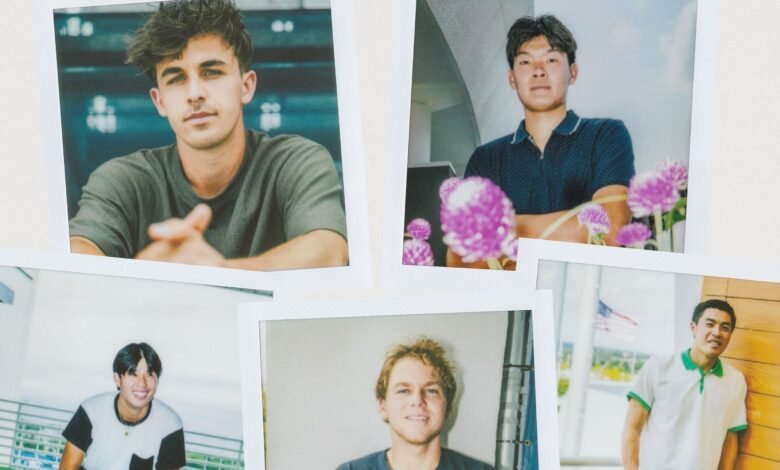
Over the course of five days in Mason, Ohio—a city on the outskirts of Cincinnati, where the Cincinnati Open is held—we met up with Tien, Nakashima, and Zheng, along with Alex Michelsen and Zachary Svajda, to not only understand a bit more about each of their games, but also get a glimpse at their (very different) personalities. The result is a dossier of singular ascendant talent.
Given how good these guys are—and combined with the established likes of Shelton, Tiafoe, Fritz, and Paul—the Slam drought might not be a media talking point for much longer. “It’s probably as exciting a time for American men’s tennis as it has been in maybe 20 years,” Amritraj says.
Learner Tien
On an astroturf-covered terrace in Mason, Learner Tien walks up in a pressed black-and-white tee, with two Van Cleef & Arpels Alhambra necklaces glinting around his neck in the heat. He looks cool. At 5’11”, Tien isn’t tall by men’s tennis standards, but what he lacks in span he makes up for in smart and agile play. He’s a lefty with a heavy topspin forehand and a tricky slicing serve. He has an all-court sensibility—really, almost a prescience—when it comes to point building that can render him very, very dangerous. In Melbourne earlier this year, he reached the quarterfinals of the Australian Open.
GQ: You recently reached a career-high ranking of 12. How did that feel?
Learner Tien: I’m very happy with how I’ve been progressing—this is only my second year on tour. I’m still young. But more than that, the focus is on improving. I’m lucky that I have a great team that can really see things well in my game, and they kind of pick apart what needs to get better. I’m always trying to improve my weaknesses… but I’m also always trying to improve my strengths, too.
What’s your favorite New York City memory, so far?
My first event on the ATP Tour was the US Open.
That’s insane.
Yeah, it was very eye-opening. It was a great experience, even though I lost in the first round. I mean, even just going into the locker room, seeing Novak in the there, it was… it was crazy. I remember when I first got the wild card that year, I saw the prize money, and I thought, “OK, no matter what, I’m set for life.” The first round payout was $80,000 or something like that. It felt like an outrageous amount of money at the time.
Do you have any superstitions?
My jewelry is a big superstition for me. If I start a tournament wearing, you know, like a certain bracelet, or a certain necklace, then I have to wear them until I’m done playing. I can’t add another necklace, and I can’t take off that bracelet.
Brandon Nakashima
As Brandon Nakashima is posing for photographs, a gust of wind lifts an otherwise stagnant American flag in the distance behind him. “It’s a paid actor,” he says, smiling. The Southern Californian has seen a resurgence in his game of late with, says Amritraj, “serves, volleys and forehands that are looking especially sharper.” In fact, Nakashima is so far the second-most accurate server on tour in 2026 (he’s tied with Jannik Sinner, trailing only Novak Djokovic). Understated in nature and quiet on the court, “BNak,” as he’s nicknamed, is something of a stealth weapon—and he’s beaten plenty of top-10 players to validate that claim. Reaching that top-10 threshold himself doesn’t feel unrealistic given the way he’s been playing this summer.
You’ve had a great past few weeks—finals in Canada, semifinals in Cincinnati. What’s clicking?
Brandon Nakashima: The biggest thing is my mentality. I feel like physically and game-wise, I’ve been able to compete with all of the top guys in the world, and I’ve shown that in the past, you know, couple of years. But I think the biggest thing right now is just being able to go out there and perform with the strongest mentality possible. That’s what’s working for me right now.
Talk us a bit through what that means.
Generally I’m a pretty, like, calm, relaxed, and laid back kind of guy. And in tough moments and pressure moments, I’m trying to stick to this—it’s what I do best.
What’s a hot take you have regarding pro tennis right now?
I don’t know if this is a hot take, but I mean—and I’m sure a lot of other players would agree here—the season is a little bit too long right now. Some more time to rest and recover would be nice in the schedule. At these big tournaments, which are getting extended, it does kind of take a lot out of you if you go deep.
Alex Michelsen In the Cincinnati heat, Alex Michelsen
Alex Michelsen
In the Cincinnati heat, Alex Michelsen leans forward, Rolex on one wrist and a Whoop fitness band on the other. Tall and lanky, he’s known for having an exceptional (and powerful) backhand, and he has a heavy first serve that’s continuing to improve. Eubanks shares a story: “I actually played Alex in Mallorca, and won the match. Then I went on to quarterfinal Wimbledon. And to this day, he still tells me, ‘I got so much confidence from losing to you, seeing what you did after, because I was right there with you. I could’ve beaten you.’ Classic Alex: he’s gonna tell you how he feels.”
What’s your favorite US Open memory?
Alex Michelsen: I have one memory from when I was a kid. I was sitting with my mom, I was probably 14, and I was watching Stefanos Tsitsipas playing Borna Coric. That was probably one of the first times in my life where I was like, man, how cool would it be if I could play like that, on that court, in front of all these people?
Did you have a tennis idol growing up?
I’ve always loved Gael Monfils. Yeah. He’s my guy. He was my guy growing up. Whenever he was on the TV, I’d stop doing homework and watch. My mom would yell at me.
Where’s the best food on tour?
One hundred percent Tokyo. They have a guy who makes sushi right in front of you. A couple of years ago they brought in a whole tuna, this big hunk of meat. I was playing when he did it, but I saw it after. The food is unbelievable.
Do you have a go-to cheat meal?
Chik-fil-A.
Zachary Svajda
Zachary Svajda is the first to arrive for our interview and photos. We find a cool spot to escape the relentless Midwestern summer humidity. At just 5’9’’, his game is built more on ultra-clean ball hitting (his hand-eye coordination is among the best) and great, all-court mobility. When he was younger, Svajda won the USTA Boys 18s not once, but twice (2019 and 2021). He also went deep at Roland-Garros earlier this year, where he reached the fourth round.
Do you have a tennis idol?
Zachary Svajda: Novak [Djokovic]. I love his game style. I love how he plays. Last year when I qualified for the US Open, I won my first round and ended up playing Novak in the second on Arthur Ashe. I’d always wanted to play him before he retires, so I’m glad I was able to, even though I lost. That was actually the last match my dad was able to watch before he passed away.
Wow. That’s very special.
It was. And Novak is a really nice guy, too. We’ve gotten to know each other a bit more since I played him. He’s tried to help me out, when he can.
What needs to happen for you to break through to the next level?
My goal is to be number one in the world. And I think it’s just about staying with it, throughout the whole year, and being a professional both on and off of the court. And I think a balance is important. You can’t be doing all tennis, all the time. And: make the most of your practices, even if that means they’re shorter.
You’re on TikTok. Any favorite audios at the moment?
I guess I like, and follow, the latest trends. In New York, I’m going to do one with “Empire State of Mind.”
Michael Zheng
Michael Zheng is sitting on the steps of the Lindner Family Tennis Center’s grandstand court. He’s talking about his mental composure, which is a highlight of his formidable game (he says that an area he’d like to improve, instead, is his physicality—he wants to add on weight). Zheng has received a wild card entry to this upcoming US Open, and he qualified for every other Slam this year—a hugely impressive feat in its own accord. He’s also a back-to-back NCAA Division 1 singles champion (2024 and 2025), and he graduated from Columbia University around the same time he quali’ed for Roland-Garros this year. He may well be New York’s next hometown hero in the making.
What’s your favorite US Open memory?
Michael Zheng: When I was really young, I had one of those giant tennis balls that people use to collect autographs. We ran into who I think was the hitting partner of Rafa Nadal, but I got them confused. I went up to him and I asked, “Hi Rafa, can you sign my ball” And the guy was like “I’m not Rafa Nadal.” But he still signed it. I did end up getting Andy Murray, though.
And as a kid, you trained at the same site where the US Open is held, right?
Yes. When I was in middle school, I’d make the commute up from New Jersey to Port Authority, then take the train out to Flushing. I did it with another kid. It was a pretty memorable time. We’d get home pretty late, like 9 or 10. It was probably an hour and a half at least, each way.
I know Roger Federer is someone you’ve long looked up to. If you could ask him for one piece of advice, what would it be?
I think probably something about serving or movement. I think he’s super underrated as a mover. Specifically, I’d ask him about finding space on the forehead—he’s probably one of the best of all time at that.
Source: www.gq.com